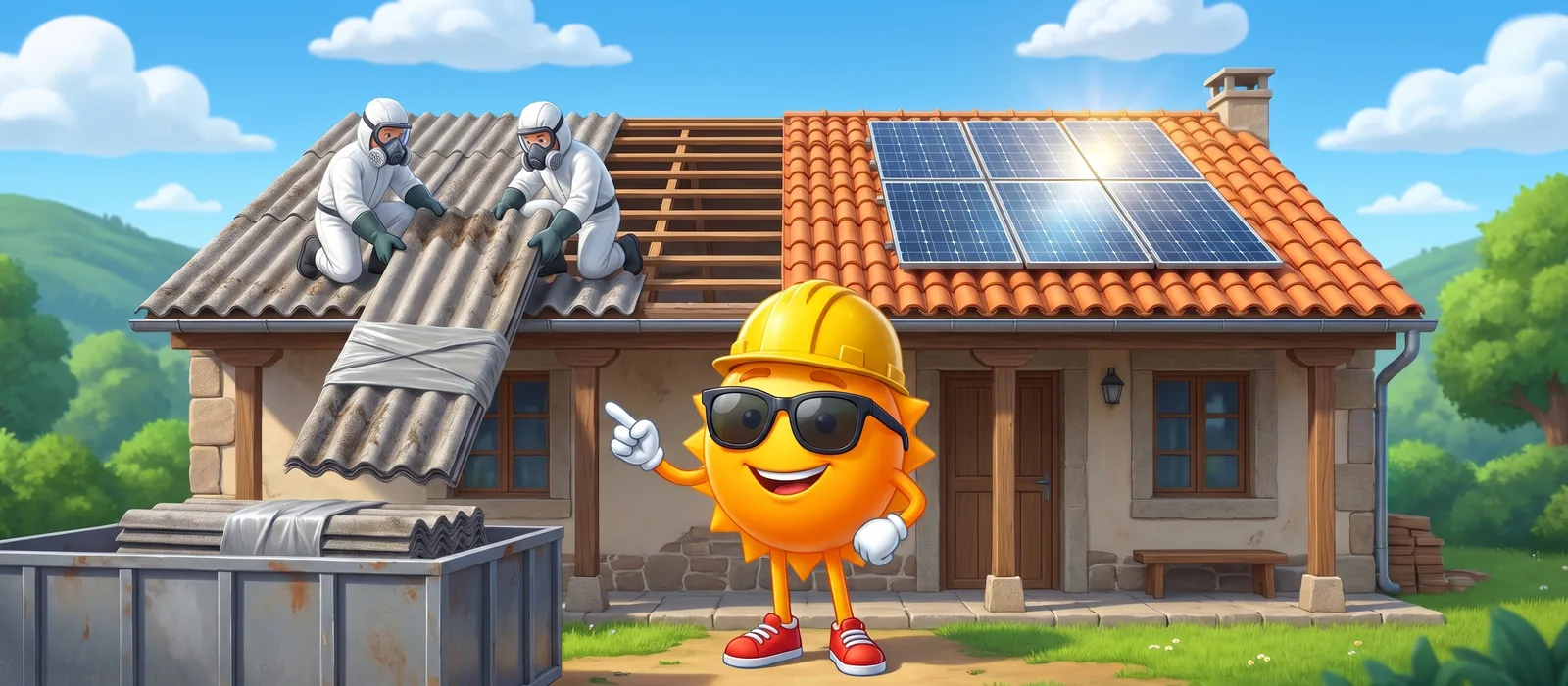
Asbestos roof: grants to replace it and add solar panels
If you have an asbestos roof (in Spain, often called "uralita"), panels can't go on top. But replacing it may cost much less than it seems: there's a grant that pays up to 80 % of the work if the house proves an energy saving, and solar panels count towards that saving.
Send us a photo on WhatsApp →
Why can't panels go on top of asbestos cement?
Because fixing the mounting structure means drilling and walking on the asbestos cement, and that releases asbestos fibres. Any work like that can only be done by a company registered in the Register of Companies at Risk from Asbestos (RERA), with a work plan approved before starting (Royal Decree 396/2006, articles 3, 11 and 17, checked on 27/10/2026). In Galicia that plan is approved by ISSGA.
And fixing panels that will last decades to a roof that will have to be replaced before them doesn't pay off. We don't install panels on asbestos cement: it's removed first, and the panels go on the new roof.
What grant is there to replace an asbestos roof?
It's the one in the 2026-2030 State Housing Plan, which the Xunta calls. Its comprehensive renovation programme also covers detached houses, in town or in the countryside (Royal Decree 326/2026, article 95 and annex II, checked on 27/10/2026). What it pays depends on the energy saving the work proves:
| Saving proved | Grant | At most |
|---|---|---|
| 45 % to 60 % | 65 % of the work | €13,000 |
| 60 % or more | 80 % of the work | €20,500 |
| Only some elements | 40 % of those elements | €7,500 |
The saving is measured in non-renewable primary energy use, or in heating and cooling demand together. Below 45 %, the full work has no band. The third row is the partial route: when only some elements of the building envelope are insulated.
Removing the asbestos counts as part of the cost of the work, as do the technician's fees, the certificates, the licence and the taxes (articles 98 and 99).
How do solar panels help reach 45 %?
The saving is measured by the energy certificate, and one of the two things it measures is the non-renewable primary energy the house uses. Panels lower that figure: the electricity they produce and you use at home is renewable. That's why, in a house with asbestos cement on the roof, the plan to reach 45 % usually combines three things:
- The new roof, with insulation. It's what lowers heating the most.
- The panels, on the new roof.
- The heating: if the house is heated with oil, switching to a heat pump is what lowers that figure the most.
Whether the panels also count as an eligible cost of the grant isn't in the royal decree: the call will say.
What does the grant require?
- A house completed before 2006.
- A project or report by a technician, and the Existing Building Book, filed at the Land Registry.
- Asbestos removal by a RERA-registered company, and a waste management study.
- An energy certificate before starting and after finishing, both registered.
- The whole envelope has to meet the insulation of the Technical Building Code: walls, roof, floor and windows. It's what decides whether it's €13,000 or €7,500. In an old house, walls and windows are usually what's missing.
- The grant is paid when the work is finished. You have to front the money, although the call may offer an advance.
- Time for the work: at most 36 months from when it's granted.
When does the grant open?
On 9 September the Xunta announced that it will publish the call at the end of 2026 and that applications will open in January 2027. It will be retroactive: work started in 2026 counts, with one condition, that it isn't finished when the call is published. There are €13.6 million for the whole of Galicia (Xunta press release, checked on 27/10/2026).
In the 2023 call it was first come, first served, until the money ran out (2023 Xunta resolution, checked on 15/10/2026). It's worth having the energy certificate and the quotes ready to apply on day one.
What isn't known yet, because the call will say: whether it will require it to be your main home, whether panels count as an eligible cost and from what date invoices are valid.
And on top of that, the income tax deduction
The grant doesn't remove the income tax deduction for improving the home's efficiency. It's subtracted from its base:
- The state one, in a house you own: up to 60 % of what you pay, on a base of up to €5,000 a year and €15,000 in total, at most €9,000 of deduction. It requires the "after" certificate to lower non-renewable primary energy by at least 30 %, or leave the house in band A or B. The work has to be paid before 31/12/2027 and the final certificate obtained before 01/01/2028 (additional provision 50 of the Income Tax Law, extended by Royal Decree-law 7/2026; Spanish Tax Agency, 2025 Income Tax Manual; checked on 27/10/2026).
- The Galician one: up to 15 % of what you pay, on a base of up to €9,000, if the rating goes up at least one band; and up to €150 for the "after" certificate. Annex III has to be filed at the Xunta's online office, and it applies in the year the work finishes: for work finishing in 2027, it depends on that year's Galician law (Legislative Decree 1/2011, article 5.dieciocho, checked on 27/10/2026).
Step by step, in the solar panel tax deduction.
If you don't replace the roof
Panels can go on the ground, on a frame in the garden, or on another roof of the house that isn't asbestos cement. We tell you where they fit and how many with the calculator, and confirm it in the study.
We'll tell you which grant applies and what it takes to reach 45 %
With a photo of the roof, your bill and what you spend on heating, we tell you which improvements would be needed, which grant you could apply for and which deductions you'd have left.
Work out for free how many panels fit on your new roof once your asbestos roof is gone.
Free satellite study →Rather talk it through? Message us on WhatsApp with a photo of the roof and your latest bill.
Frequently asked questions
Can solar panels go on top of asbestos cement?
We don't install them: fixing them means drilling and walking on the asbestos cement, which releases asbestos fibres. Any work like that has to be done by a RERA-registered company, with an approved work plan. The asbestos cement is removed first, and the panels go on the new roof.
What grant is there to remove an asbestos roof?
The renovation grant of the 2026-2030 State Housing Plan, called by the Xunta: up to 65 % of the work (at most €13,000) if the house proves a 45 % to 60 % energy saving, and up to 80 % (at most €20,500) if it reaches 60 %. Removing the asbestos counts as a cost.
When can you apply for the Xunta grant to replace the roof?
The Xunta announced that it will publish the call at the end of 2026 and that applications will open in January 2027. Work started in 2026 that isn't finished when the call is published counts.
Do solar panels help to get the grant?
Yes, because they lower the non-renewable primary energy the certificate measures, and that counts towards the 45 % saving. Whether they also count as an eligible cost of the grant, the call will say.

Solariña
We design and install solar self-consumption systems for homes all over Galicia, mainly in the province of A Coruña. Every study starts from your bill and your measured roof; the work is done by an authorised installer, who signs the electrical certificate, and the energy certificates are signed by a qualified technician. If something doesn't pay off for you, we'll tell you.