
Solar panels to charge an electric car: how many you need
An electric car can use more electricity in a year than the rest of your house. Here's how to work out how many extra solar panels it needs, whether your contracted power is enough and what time of day it's best to charge it.
Free satellite calculator →
How much does an electric car use?
An example with round numbers: a car that does 15,000 km a year on electricity and uses 17 kWh per 100 km needs 2,550 kWh a year, and with what's lost when charging, about 2,800. That's a lot of electricity: in many homes, more than everything else combined.
So if you're going to have an electric car, the panels should be sized with it from the start. Adding them later costs more than installing them all at once.
How many more panels do I need for the car?
To work out how many solar panels to charge an electric car you need, the calculation has three steps:
- What the car uses in a year: the kilometres you drive on electricity times the kWh per 100 km on its spec sheet, plus 8-10 % lost when charging.
- What one panel produces on your roof: in A Coruña, a 535 W panel on a south-facing roof with no shade gives about 670 kWh a year. With another orientation or shade, less.
- How much surplus makes sense: with a tariff that has a "wallet" (virtual battery), what's left over in the sunny months pays for the darker ones. That's why panels aren't sized tight. How much extra depends on your consumption and your tariff, and we tell you in the study.
With the example's numbers:
| Step | Example |
|---|---|
| Kilometres a year on electricity | 15,000 km |
| What the car uses | 17 kWh per 100 km |
| What it needs a year, with charging losses | about 2,800 kWh |
| What a 535 W south-facing panel gives in A Coruña | about 670 kWh a year |
| Panels just for the car | about 4, and a few more for a summer surplus |
Why produce more? Because what's left over in the sunny months isn't thrown away: with a "wallet" tariff it's saved in euros and pays the rest of the bill, including the power charge. That's how those months end up at zero. How that balance and the battery share the work is explained in solar battery and virtual battery.
Is my contracted power enough to charge the car?
Almost always, yes. A charger with load balancing measures what the house uses and charges the car only with what's left of your contracted power. At night the house uses little: with 3.45 kW contracted there are about 3 kW free, and the eight off-peak hours fit about 20 kWh. The example car needs about 8 kWh a day.
Increasing your contracted power is paid every month, whether you charge or not. It only makes sense if the house is already tight with everything on, for example with a heat pump, and even then there's no room for the car at night.
What the charger involves, what moves its price and how it's fitted in a shared garage: EV charger installation in A Coruña.
What time is best to charge the car?
In the early hours. With the 2.0TD tariff for homes, from Monday to Friday the off-peak hours run from 0:00 to 8:00, and Saturdays, Sundays and national holidays are off-peak all day. It's the cheapest electricity you'll buy, and you don't need a battery for it: just schedule the charge in the car or the charger.
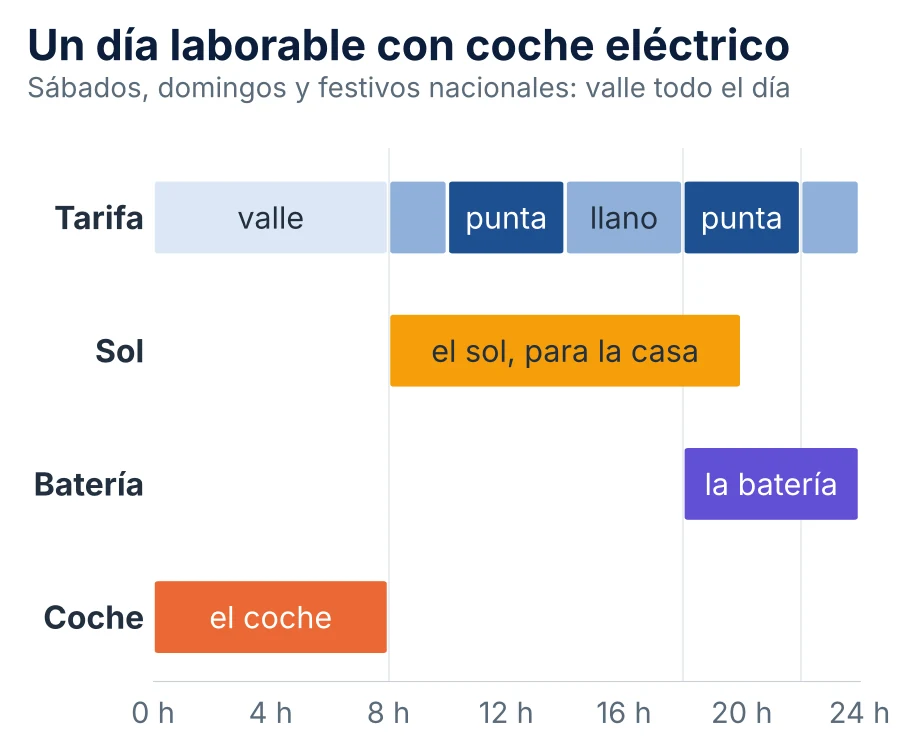
- The house, in the expensive hours: direct sun in the day and the battery in the evening and at night.
- The car, in the early hours: from the grid, at off-peak price.
- The panels' surplus: if your tariff has a "wallet", to that balance, which pays the rest of the bill, including the car's share.
What about charging with surplus sun? You can, and at weekends it's easy. But it saves less than it seems, because that sun was already being paid as surplus. We explain it in the EV charger article.
What about the home battery? The house first; the rest, the car
A home battery is worth more the more expensive the hour it saves you: that's why it's best kept for the house in peak and mid-peak hours, not for the car.
Don't expect it to charge the car: a home battery stores about 5 kWh, and a car can need more than that every night. And don't drain it into the car at the expense of the evening: the next day you'd buy at peak what the car took off-peak.
What about tax deductions?
There are two, and each covers its own part:
- The charger: 15 % of what you pay, up to €600, if it's installed and paid for before the end of 2026. The conditions are in the EV charger article.
- The panels: up to 60 % in a house, if the energy certificate after the work shows the improvement the law requires compared with the one before.
We size your panels and charger around your kilometres
We look at your bill, your contracted power, the kilometres you drive and your roof, and tell you how many panels you need and whether a battery pays off, without inflating anything.
Solar panels to charge an electric car: work out for free how many fit on your roof.
Free satellite study →Rather talk it through? Message us on WhatsApp with your car model, the kilometres you drive and your latest bill.
Frequently asked questions
How many more solar panels do I need if I have an electric car?
It depends on the kilometres you drive on electricity and on your roof. With round numbers, a car doing 15,000 km a year uses about 2,800 kWh, and in A Coruña a south-facing panel gives about 670: about 4 panels just for the car, and a few more for a summer surplus.
Do I have to increase my contracted power to install a charger?
Hardly ever. A charger with load balancing measures what the house uses and charges the car with what's left. At night, with 3.45 kW contracted, the eight off-peak hours fit about 20 kWh.
What time is best to charge the car if I have panels and a battery?
In the early hours, off-peak, straight from the grid. The battery is kept for the house in the expensive evening and night hours, where it saves the most.
Can I charge the car with the home battery?
Only with what's left after covering the house. A home battery stores about 5 kWh, and draining it into the car would make you buy at peak what it took off-peak.

Solariña
We design and install solar self-consumption systems for homes all over Galicia, mainly in the province of A Coruña. Every study starts from your bill and your measured roof; the work is done by an authorised installer, who signs the electrical certificate, and the energy certificates are signed by a qualified technician. If something doesn't pay off for you, we'll tell you.